


Regulation in Brief
The Bureau of Indian Standards (BIS) is the national standardization body of India. The BIS Act, 2016, along with the associated Rules and Regulations, provides a framework for offering third-party assurance of the quality, safety, and reliability of products to consumers.
Under the BIS Act, 2016, BIS Rules, 2018, and BIS (Conformity Assessment) Regulations, 2018, provisions for the Grant of Licence (GoL) are outlined. These regulations apply to both domestic and foreign manufacturers seeking BIS certification for products listed under Scheme I.
Quality Control Orders (QCOs)
Quality Control Orders (QCOs) are mandatory directives issued by the Central Government of India under the BIS Act, 2016. These orders make BIS certification compulsory for specific products before they can be manufactured, imported, sold, distributed, or stored in India. Once a QCO comes into effect, no person can deal in the covered products without a valid BIS licence and the ISI Standard Mark.
QCOs are issued by various Line Ministries and Departments of the Government of India after consultation with BIS. The orders are equally applicable to both Indian manufacturers and foreign manufacturers. Any person who contravenes the provisions of a QCO is punishable under Section 29 of the BIS Act, 2016 with imprisonment, fine, or both.
For foreign manufacturers, products covered under a QCO must be certified through the Foreign Manufacturers Certification Scheme (FMCS). The BIS has been rapidly expanding the scope of QCOs — over 84 QCOs have been issued in recent years covering more than 343 products across categories including chemicals, steel, aluminium, textiles, footwear, toys, electrical appliances, and many more.
Manufacturers and importers are advised to regularly check the BIS website for the latest list of products under compulsory certification and upcoming QCOs: BIS Compulsory Certification Products
|
Foreign Manufacturers |
Domestic Manufacturers |
|
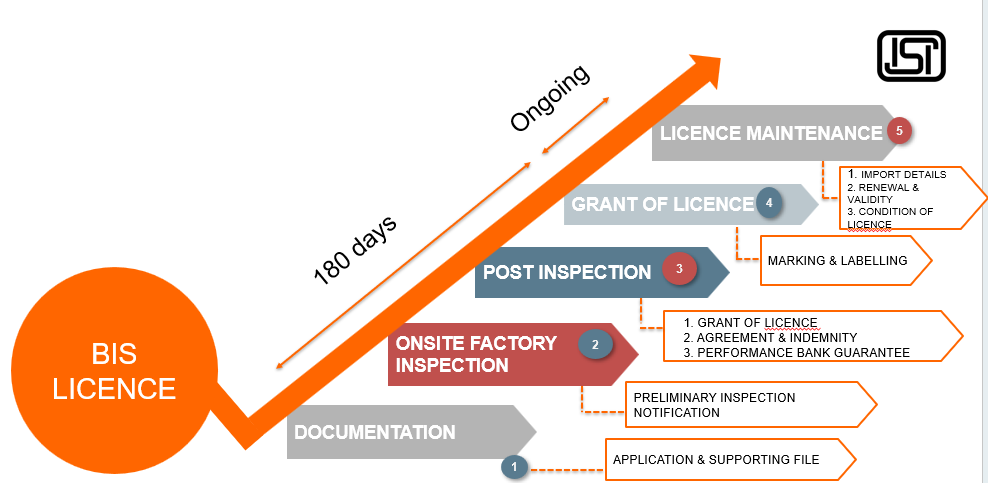
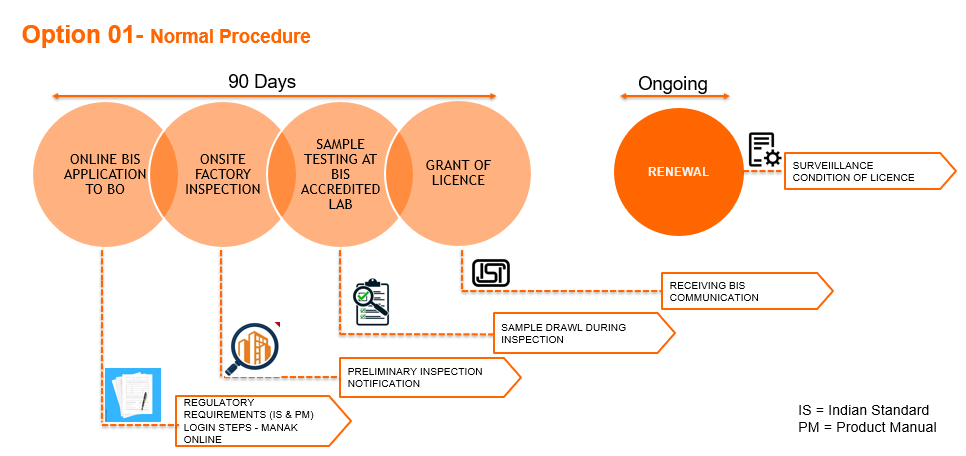
Foreign manufacturers can obtain a licence to use the Standard Mark on products that comply with the applicable Indian Standards under the Foreign Manufacturers Certification Scheme (FMCS). To apply, the manufacturer must appoint an Indian resident as an Authorized Indian Representative (AIR). The application process is online, and the overall timeline for obtaining the licence is typically longer. Timeline: Generally around 6 months or more |
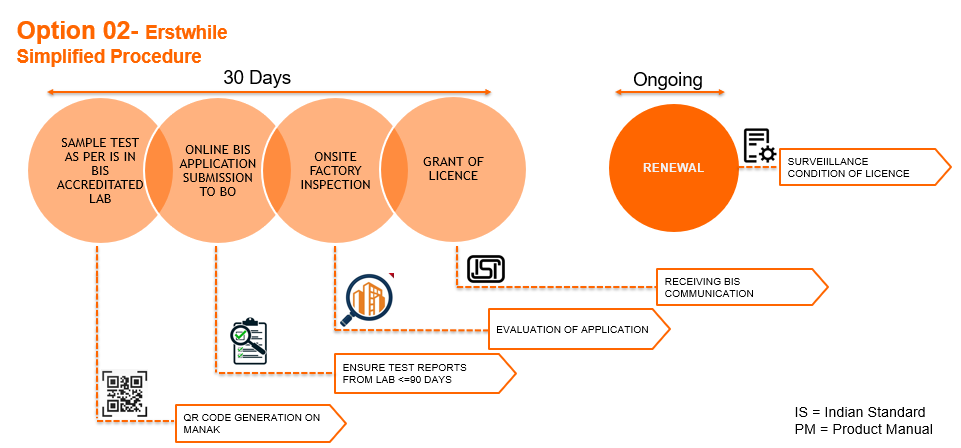
Domestic manufacturers can obtain a licence to use the Standard Mark through the BIS Product Certification Scheme for products conforming to relevant Indian Standards. The application process is conducted online, and the typical timeline for obtaining certification is approximately 2–3 months. Timeline: Approximately 2–3 months |
Product Categories Supported by REACHLaw








Process for Getting a BIS Certificate
Foreign Manufacturer:
Domestic Manufacturer:
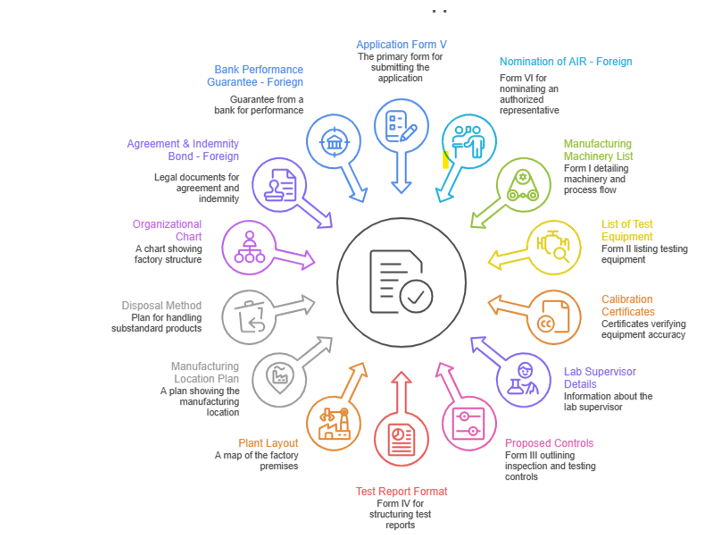
What Documents Are Required?
BIS Certification Fees & Costs
The total cost of BIS certification varies depending on the product category, testing requirements, and the certification scheme. Below is an overview of the key fee components that manufacturers should plan for when applying for a BIS licence under Scheme I.
|
Fee Component |
Foreign (FMCS) |
Domestic |
|
Application Fee |
As per BIS schedule |
As per BIS schedule |
|
Annual Licence Fee |
As per BIS schedule |
As per BIS schedule |
|
Minimum Marking Fee (Advance) |
Based on product category |
Based on product category & turnover |
|
Factory Inspection Charges |
Travel, stay & inspection of BIS officials to be borne by applicant |
Covered by BIS |
|
Product Testing Fees |
Paid to BIS-accredited lab in India; samples shipped by applicant |
Paid to third-party lab or BIS lab |
|
Performance Bank Guarantee (PBG) |
USD 10,000 (refundable security) |
Not applicable |
|
Agreement & Indemnity Bond |
Required |
Not applicable |
|
Renewal Fee |
Annual; based on marking fee & volumes |
Annual; Annual; based on marking fee & volumes |
|
Late Renewal Penalty |
₹5,000 if renewed after expiry |
₹5,000 if renewed after expiry |
Note: The marking fee is calculated based on the actual volume of products exported to India or manufactured in India and marked with BIS standard mark and is paid annually. The BIS fee schedule is updated periodically. For the latest fee details, refer to: BIS FMCS Fee Schedule.
For SAARC countries, payments can be made in either USD or Indian Rupees (INR) including GST. For all other countries, payments must be made in USD only.
Key Penalties and Legal Consequences
|
Fines: Initial offenses carry a fine of no less than ₹1,00,000, while subsequent offences can lead to fines of ₹5,00,000 but may extend up to ten times the value of goods or articles produced or sold or offered to be sold. |
|
Imprisonment: Up to two years for selling, manufacturing, or importing goods without the mandatory ISI mark. |
|
Seizure and Action: The BIS can conduct raids, seize products without the mark, and initiate legal action. |
|
Stop-marking/Sales Ban: Authorities can ban the sale of products, order product recalls, and cancel BIS licenses. |
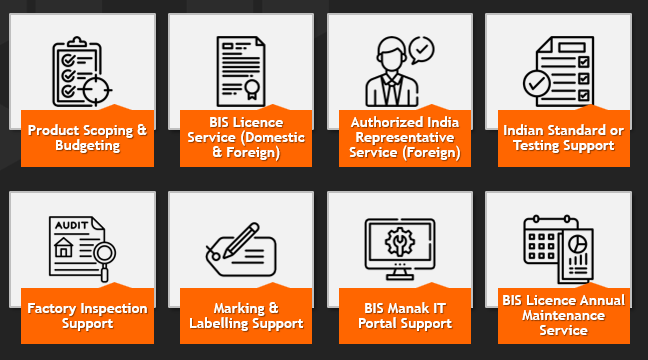
Our Support with BIS Scheme I Certificate
Why REACHLaw?
REACHLaw: Trusted Global Experts in Chemical and Product Regulations
REACHLaw is an international regulatory consultancy, trusted worldwide for delivering expert, practical, end-to-end compliance solutions in chemical and product regulations. Since 2008, we have helped the global chemical industry and related sectors to achieve compliance and a smooth, timely, and sustainable market access for their chemical products. Headquartered in Helsinki, Finland and with offices across Europe and Asia, we support over 1,000 clients from more than 60 countries, providing tailored, actionable solutions for complex compliance challenges.
BIS Compliance in India – Trusted BIS Partner
Through REACHLaw India Pvt. Ltd., with offices in New Delhi and Mumbai, we provide comprehensive Bureau of Indian Standards (BIS) support – as an Authorized Indian Representative and full-service regulatory partner.
From licensing and representation to post-certification support, our long-standing presence in India and close engagement with BIS authorities ensure efficient, reliable outcomes for both local and foreign manufacturers.
Partner with REACHLaw India for trusted BIS compliance expertise, regulatory foresight, and seamless market access to India and worldwide.
Frequently Asked Questions (FAQ)
|
Q: 1. What is Foreign Manufacturer Certification Scheme (FMCS) or India BIS Licence? This certification scheme is designed for foreign manufacturers seeking BIS (Bureau of Indian Standards) Licence approval. It applies to products other than Electronic and Information Technology (IT) products. For Electronic and IT products, please refer to the Registration Scheme (CRS). |
|
Q: 2. Is BIS Licence mandatory to access the Indian market? Typically, BIS certification schemes are voluntary. However, certain products specified by the Government of India under Quality Control Orders (QCOs) must bear the Standard Mark and have a valid BIS licence to be imported into India. |
|
Q: 3. Is the nomination of AIR a mandatory requirement under FMCS? Yes, the foreign applicant must nominate an Indian Resident as an Authorized Indian Representative (AIR) when submitting the application. |
|
Q: 4. Who is eligible to be considered an AIR? The Authorized Indian Representative (AIR) must be an Indian resident who agrees to assume responsibility for complying with the provisions of the BIS Act, rules, regulations, and terms & conditions specified in the BIS Licence. Each AIR represents only one manufacturing firm and cannot act as AIR for other foreign manufacturers, except for those within the same group of companies. |
|
Q: 5. Does the AIR need to be a resident of India? The AIR should be a resident of India and an Indian national. However, a foreign national may also serve as AIR if employed in any office or branch of the manufacturer in India, provided that individual resides in India. |
|
Q: 6. Is it possible for a manufacturer to change its AIR? Yes, the manufacturer has the right to change its nominated AIR. BIS should be informed about this change without delay. |
|
Q: 7. Should the payment for FMCS be made in INR or USD? For SAARC countries, payments can be made in either USD or Indian Rupees (INR) including GST. For all other countries, payments must be made in USD only. |
|
Q: 8. Can test reports conforming to standards other than Indian Standards (e.g. IEC) be accepted? No, only the test report that complies with the relevant Indian Standard will be accepted. |
|
Q: 9. What is the timeline for obtaining the BIS licence? The average time to grant a license is generally six months from the date of receipt of a complete application. However, this may vary due to delays in responding to queries, organizing inspections, transporting samples, and remitting dues. |
|
Q: 10. Can a manufacturer submit a single application for multiple products at the same factory? No, a separate application for each product/Indian Standard Specification (ISS) must be submitted for each factory location. |
|
Q: 11. Can a manufacturer submit a single application for the same product manufactured at multiple locations? No, a separate application must be submitted for each product or Indian Standard Specification (ISS), and for each factory location. |
|
Q: 12. As an importer, am I allowed to apply for a license on behalf of the manufacturer? No, under the FMCS scheme, the application must be made by the foreign manufacturer themselves. |
|
Q: 13. What is the validity period of the BIS license? BIS certification under Scheme-I may be initially granted for a period of 1 or 2 years upon payment of the advance minimum marking fee. The license is valid only for the specific varieties mentioned therein. |
|
Q: 14. Does the quantity of chemical import/export matter for BIS licence? Yes, the quantity is used to calculate the marking fee paid annually and you need to record volumes for maintenance of license in accordance with the conditions defined under the regulation. |
|
Q: 15. Can we use our supplier’s BIS license to import chemicals into India? If your supplier is a foreign manufacturer who has obtained the BIS license, then you can import chemicals in India only from that specific site mentioned on the license. |
|
Q: 16. Does BIS apply to chemical mixtures? No, it only applies to pure chemicals. Please refer to the scope of product in Indian Standard for details. |
|
Q: 17. If we discontinue the license, can the bank guarantee be refunded? The Performance Bank Guarantee (PBG) will remain in force during the period the licence is valid and will be discharged or refunded only once all dues are settled. |
|
Q: 18. Can the product sample drawn during inspection be tested in any government lab in the country of manufacture? No, samples drawn during inspection shall only be tested in laboratories accredited or recognized by BIS. The samples shall be sent to a laboratory in India by the applicant firm. |
|
Q: 19. Do I need separate applications for different brands of the same product at the same location? No, the licence application is specific to a product manufactured at a particular premise. The firm must submit an undertaking for the brand name along with relevant documents. |
|
Q: 20. Is there a technical manual available to help applicants? Yes, Product Manuals are available for various Indian Standards under certification. These documents include Scheme of Inspection and Testing (SIT), guidance for product testing, sampling, marking & labelling, and test certificate templates. |
|
Q: 21. What information does the customs officer require at entry point? Standard labelling & marking information mentioned in the Indian Standard of the product under BIS list will be checked by the inspector at the entry port. |
|
Q: 22. What is meant by Lab In-charge? How does testing work for foreign manufacturers? Lab in charge means the head person of your lab responsible for testing and method development. Testing must be done as per the relevant IS standard at your own premises. Samples drawn by the inspector during the visit will be tested in a BIS-accredited lab in India. |
|
Q: 23. Do foreign manufacturers have to deposit an Indemnity and guarantee fee to BIS? Yes, foreign manufacturers must sign an indemnity and provide a Performance Bank Guarantee of USD 10,000 as security against any loss or damage caused to the Bureau by breach of licence conditions. |
|
Q: 24. Is the ISI Mark required regardless of import quantity? Yes, the ISI mark is required for all chemicals/products listed irrespective of quantities. |
|
Q: 25. Can a licence be provided if no manufacturing audit is possible? No, audits/inspections are mandatory for the grant of licence. |
|
Q: 26. Can different alike products from the same location be combined into one application? No, a separate application for each product and Indian Standard is to be submitted for each factory location. |
|
Q: 27. Does BIS assign a separate licence number per application? Yes, a separate licence number is assigned per product/Indian Standard. |
|
Q: 28. What is Manak Online? Does a foreign manufacturer need to create an account? Manak Online is the electronic system developed by BIS for various activities related to standards and certification in India. Yes, a foreign manufacturer needs to create an account after grant of licence. |
|
Q: 29. Do we need to report details of each ISI marked consignment? Yes, details of each consignment need to be uploaded on Manak Online before the estimated date of arrival of shipment. |
|
Q: 30. What is market surveillance? BIS draws samples of ISI marked products from the market for testing at BIS-recognized labs to verify conformity with the applicable Indian Standard. |
|
Q: 31. Who is responsible for submitting samples during market surveillance? It is the importer’s responsibility to provide samples of the requested lot to BIS. The manufacturer must coordinate with the importer for timely submission. |
|
Q: 32. What is marking fee? It is the fee paid towards the use of the ISI mark on a product after grant of licence. Minimum marking fee is paid in advance during the grant of licence, and thereafter marking fee is paid based on actual export quantities to India. |