


Regulation in Brief
The Bureau of Indian Standards (BIS) is the national standardization body of India. The BIS Act, 2016, along with the associated Rules and Regulations, provides a framework for offering third-party assurance of the quality, safety, and reliability of products to consumers.
Under the BIS Act, 2016, BIS Rules, 2018, and BIS (Conformity Assessment) Regulations, 2018, provisions for the Grant of Licence (GoL) are outlined. These regulations apply to both domestic and foreign manufacturers seeking BIS registration for products listed under Scheme II.
Quality Control Orders (QCOs)
Quality Control Orders (QCOs) are mandatory directives issued by the Central Government of India under the BIS Act, 2016. These orders make BIS certification compulsory for specific products before they can be manufactured, imported, sold, distributed, or stored in India. Once a QCO comes into effect, no person can deal in the covered products without a valid registration.
Ministry of Electronics & Information Technology (MeitY), Ministry of New and Renewal Energy (MNRE), Ministry of Chemicals and Fertilizers and Ministry of Textiles has notified QCO under compulsory registration scheme.
Bureau of Indian Standards grants registration to the manufacturers to use or apply Standard Mark with unique R-number, through registration based on self-declaration of conformity for goods and articles as per Indian Standards. The grant of licence and its operation under Compulsory Registration Scheme are carried out as per the conformity assessment scheme under Scheme – II of Schedule – II of BIS (Conformity Assessment) Regulations, 2018
As per the Orders, no person shall manufacture or store for sale, import, sell or distribute goods which do not conform to the Indian standard specified in the order and do not bear the Standard Mark with unique registration number obtained from BIS.
Manufacturers and importers are advised to regularly check the BIS website for the latest list of products under compulsory registration scheme.
Foreign Manufacturers
Foreign manufacturers can obtain registration to use the Standard Mark on products that comply with the applicable Indian Standards under the Compulsory Registration Scheme.
To apply, the manufacturer must appoint an Authorized Indian Representative (AIR). The application process is online, and the overall timeline for obtaining the licence is 1-2 months excluding testing.
Domestic Manufacturers
Domestic manufacturers can obtain a registration to use the Standard Mark on products that comply with the applicable Indian Standards under the Compulsory Registration Scheme.
The application process is conducted online, and the typical timeline for obtaining certification is approximately 1–2 months excluding testing.
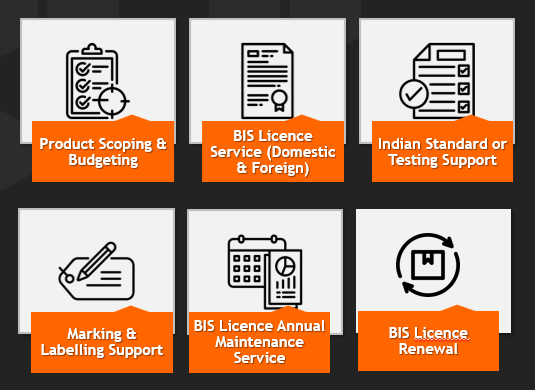
Product Categories Supported by REACHLaw



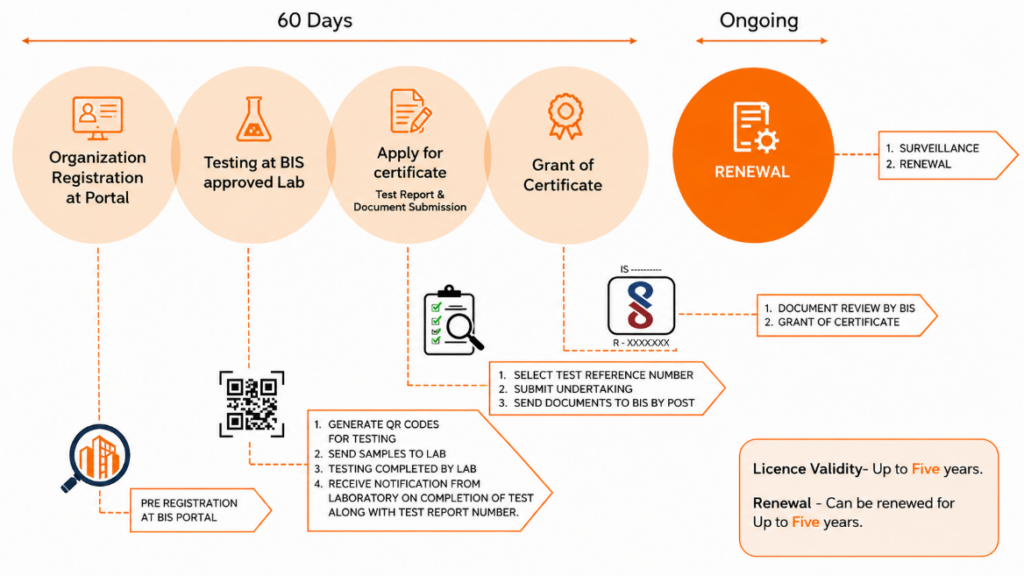
Process for getting Compulsory Registration Certificate
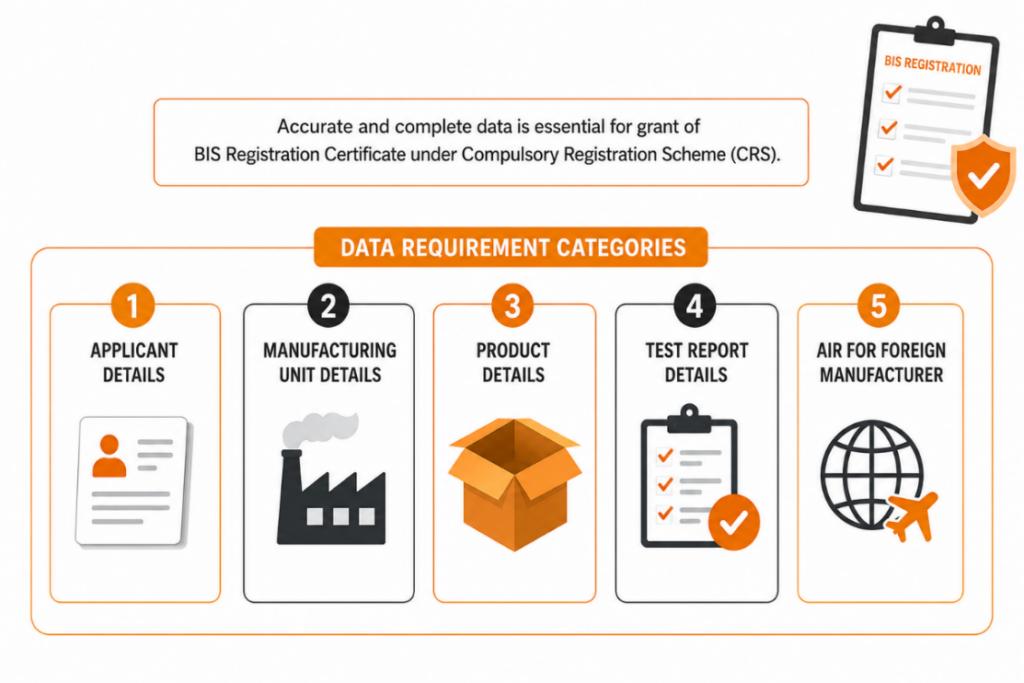
What documents are required?
BIS Registration Fee:
Fee for new application
|
Sl. No. |
Title |
Fee |
|---|---|---|
|
1. |
Application Fee |
₹ 1000/- |
|
2. |
Annual Licence Fee |
₹ 1000/- |
|
3. |
Application processing fee* (inclusive of 1 test report) |
₹ 25000/- |
|
4. |
Fee for additional test report (per test report) |
₹ 20000/- |
Fee for Inclusion
|
Sl. No. |
Title |
Fee |
|---|---|---|
|
1. |
Inclusion fee (inclusive of 1 report) |
₹ 30000/- |
|
2. |
Fee for additional test report(per test report) |
₹ 20000/- |
Fee for renewal
|
Sl. No. |
Title |
Fee |
|---|---|---|
|
1. |
Application Fee |
₹ 1000/- |
|
2. |
Annual Licence Fee |
₹ 1000/- |
|
3. |
Renewal processing fee * |
₹ 25000/- |
|
4. |
Additional fee in case renewal is requested for more than 2 year (to be charged per year)* |
₹ 25000/- |
* Concession in processing fee of 80 % shall be applicable to micro enterprises and start-ups, 50 % shall be applicable to small enterprises and 20 % shall be applicable to medium enterprises till 31st May 2029 and 20 % shall be applicable to all enterprises from 1st day of June, 2029 onwards.
Key Penalties and Legal Consequences
- Fines:Initial offenses carry a fine of no less than ₹1,00,000, while subsequent offences can lead to fines of ₹5,00,000 but may extend up to ten times the value of goods or articles produced or sold or offered to be sold.
- Imprisonment: Up to two years for selling, manufacturing, or importing goods without the mandatory BIS mark.
- Seizure and Action: The BIS can conduct raids, seize products without the mark, and initiate legal action.
- Stop-marking/Sales Ban:Authorities can ban the sale of products, order product recalls, and cancel BIS licenses.
Our Support with Compulsory Registration Scheme II
Why REACHLaw?
REACHLaw: Trusted Global Experts in Chemical and Product Regulations
REACHLaw is an international regulatory consultancy, trusted worldwide for delivering expert, practical, end-to-end compliance solutions in chemical and product regulations. Since 2008, we have helped the global chemical industry and related sectors to achieve compliance and a smooth, timely, and sustainable market access for their chemical products. Headquartered in Helsinki, Finland and with offices across Europe and Asia, we support over 1,000 clients from more than 60 countries, providing tailored, actionable solutions for complex compliance challenges.
BIS Compliance in India – Trusted BIS Partner
Through REACHLaw India Pvt. Ltd., with offices in New Delhi and Mumbai, we provide comprehensive Bureau of Indian Standards (BIS) support – as an Authorized Indian Representative and full-service regulatory partner.
From licensing and representation to post-certification support, our long-standing presence in India and close engagement with BIS authorities ensure efficient, reliable outcomes for both local and foreign manufacturers.
Partner with REACHLaw India for trusted BIS compliance expertise, regulatory foresight, and seamless market access to India and worldwide.
Q1. The Compulsory Registration Order (CRO) will be effective based on manufacturing date or import date?
The date of manufacturing for domestically produced goods and date of landing of consignments in India for goods manufactured overseas would apply for consideration against deadlines notified.
Q2. What would be the status of goods already in stock and in the market?
The products manufactured / imported before the due date of coming into effect Order will be grandfathered and are not covered under the ambit of the Order.
Q3. What will happen to goods ordered and expected to come on or after the due date (on account of deferment of shipments) or in transit?
The goods landing at Indian ports on or after the due date must comply with the requirements of Order.
Q4. Who is eligible to get Unique Registration Number – the manufacturer or importer?
The manufacturer is eligible to apply and get unique registration number which is linked to manufacturer, location of factory, product and brand.
Q5. If being manufactured by OEM and the product is already carrying CE, UL & FCC mark or tested as per international safety standard in overseas lab or a CB testing lab – do these products have to be retested or submission of test report from OEM supplier is enough for registration.
The BIS Rules require a valid test report (not older than 90 days) from any BIS recognized test laboratory to be submitted while applying for Compulsory Registration. The test reports issued by BIS Recognized Labs as per the notified Indian Standards are only accepted for Registration.
Q6. What is the validity of test report?
The provision is guided by BIS Rules, as notified from time to time. As per the current BIS Rules, as notified from time to time, the test report shall not be older than ninety days as on the date of submission of application online as well as physical application for registration.
Q7. Standard Mark will be on the product or packaging?
As per the best practices, the Standard Mark shall be placed on the product & the packaging both however, if it is not feasible to place the same on the product for size constraints, it can be put on the packaging only. For the products with display screen, provisions of e-labelling of products also exist. However, the marking requirements as specified in BIS Act or BIS rules or BIS Conformity Assessment Regulations would prevail.
Q8. What should the label display?
Label should display the Standard Mark as per Bureau of Indian Standards (Conformity Assessment) Regulations amended from time to time.
Q9. If manufacturers are manufacturing under multiple brands, is registration required for each brand?
Different brands are required to be registered separately. However, it is feasible to do so based on a common test report, if the product and the manufacturing location are the same.
All brands with respective model numbers should be listed in the test report. Test samples of all brands are not required to be submitted. However, product labels for respective brands must be placed in the test report. Lab may also include statement about coverage of this brand and respective model numbers to be covered based on the representative model tested and the declaration submitted by the manufacturer about multiple brands and respective model numbers.
Q10. If product is certified at one manufacturing location, is it necessary that registration for that same product manufactured at other locations is done again?
The unique registration number provided by BIS is for unique manufacturing location. Hence, separate application has to be made for each location and supported with a test report for product manufactured at that manufacturing location.
Q11. Who will bear the cost of registration?
As per the provision of BIS Act & BIS Rules, the costs, including those of surveillance, are to be borne by the registered entity.
Q12. Is it required to get the product retested from a lab prior to renewal?
The renewal is done by BIS on submission of renewal application in prescribed format by the registered user. The renewal application along with requisite fee shall be submitted at least one month in advance from the date of expiry of registration. Repeat testing is not specifically envisaged. However, test samples would be picked up for testing during surveillance.
As indicated in the Gazette Notification S.O. 1248(E) dated 18.03.2021, the latest version of Indian standards including the amendments issued thereof, as published and notified by the Bureau from time to time, shall be applicable from the date as notified by the Bureau.
Q13. Who is liable for testing of imported products – Importer or Foreign Manufacturer?
It is the responsibility of manufacturer or its authorized Indian representative to get the products registered with BIS.
Q14. Will the supplier’s test report be good enough for self-declaration for importer or trading company?
The supplier’s test report is not acceptable.
Q15. What is the process of collecting product from foreign manufacturer?
It is the responsibility of manufacturer to get the products tested from any BIS recognized laboratory and seek registration from BIS, however, during surveillance the products will be picked up from the market or from the local representative of the foreign manufacturer.
Q16. What is the time period for testing / collection / registration?
The time period of testing depends upon the work load of the laboratory chosen by the manufacturer and submission of requisite technical details by the manufacturer for testing the product. Samples for initial registration can be submitted directly to any of the BIS recognized labs by the manufacturer. The registration will promptly be processed by BIS if all submitted documents are in order. Independent samples are picked up only during surveillance process.
Q17. Can the manufacturer apply for recognition with BIS at its own testing laboratory?
Manufacturer’s test laboratories are not entitled for recognition with BIS.
Q18. Which of the BIS recognized labs can be approached for testing of products?
The list of BIS recognised labs for each product / standard is available on BIS web site https://www.crsbis.in/BIS/
Q19. How would identical models with minor changes be accommodated for registration without any testing?
Please refer to the series guidelines for series approvals, which are available on MeitY website https://meity.gov.in/esdm/standards
Q20. How to address if alternate sources are developed for same approved specifications? What will happen if the circuit or components are changed?
Pre-certified safety critical components (valid) of same ratings from different sources may be used under intimation to BIS alongwith copy of certificate, however, if Circuit / design / component changes, retesting of the product is required.
Q21. If product is required to be sent abroad for maintenance, do we need to submit the product before custom clearance?
Products sent abroad for maintenance are allowed to be brought in without BIS registration number provided the model number/serial number does not change. In case of faulty units replaced with new units of a different serial number, the new units would attract provisions of Order.
Q22. In case plant is outside India, who will communicate with manufacturer?
Manufacturer authorizes All India Representative (AIR) under this scheme. All the communications by BIS/MeitY are addressed to the registered entity and its authorized Indian representative.
Q23. Will the Compulsory Registration Order apply to spare parts of the notified products? Will the order apply to an item used as a replacement of a faulty unit?
The Compulsory Registration Order applies to finished goods and not the spare parts/components used in the manufacturing of the finished goods, unless they are notified separately as independent products under CRO. Further, the import of the notified items in CKD (complete knock down) condition is allowed. However, for the import of notified goods, in SKD (semi knock down) condition, the import should be allowed only to the manufacturer of the end finished product which are having IEM license for manufacturing the same. If the products are imported in SKD condition, the customs shall ensure that the importer has valid authorization from the brand owner for assembling/manufacturing the end product.
Q24. Will it be possible to get future models included in existing series (as part of 10 models in a series) after Grant of Registration to the representative model already registered?
New products can be included in the existing Registration number with the following process –
Technical details of the new product along with the existing Series and test report to be submitted to the Labs for validation.
Validation report from Lab along with existing registration number for a series needs to be submitted to BIS along with processing fee.
Q25. Would cells and batteries require to be independently registered?
These items are required to be independently registered. However, a battery using registered cells would only list cells in the CDF of the battery and testing on registered cell is not expected to be done as part of battery.
Q26. What is the definition of portable application? Batteries, cells, power banks themselves are portable but they can be used in non-portable devices, laptop, mobile phone, etc.
It is clearly defined in clause 3.14 of the standard IS 16046 (Part-I and II) applicable to Secondary Cells / Batteries. As per the definition “a battery for use in a device or appliance which is conveniently hand carried is a portable battery and cells intended for assembly in a portable battery is a portable cell”. The products laptop, mobile phone are examples of portable appliances. If batteries can find a dual application i.e. for Potable/ non-portable, then they also require registration from BIS.
Q27. How will the battery of a product be tested if it is an integral part of the product and cannot be detached?
Sealed Secondary Cells/Batteries are covered under the Compulsory Registration Order with effect from 01.06.2016 and hence require mandatory BIS registration even if they form an integral part of the host product provided the host product is also covered under the Order. For products that are not covered under the order (for e.g shavers and trimmers etc), the batteries which are integral part of the product are not covered. However, if they are subsequently imported as standalone products, they require registration under the Compulsory Regulation Order.
Q28. What registration number will a consolidated product (like laptop / mobile) using the battery and adaptor display?
Registration is required for Power Adaptors & Batteries also, as these are independently notified under CRO, and hence these items must independently be registered, and in turn, support the registration label. Similarly, the consolidated product (e.g. laptop / mobile) would only bear the registration no. of the overall product, i.e., Laptop/Mobile itself. Label for respective sub parts, like: Adaptor & Battery would independently be visible on these subparts when these items are disintegrated from the main product.
Q29. Does BIS Registration require original test report to be submitted for each brand covered based on the common testing report for multiple brands?
For registration of multiple brands, photocopies of original report authenticated by the test lab could be submitted to BIS.
Q30. Whether samples of all models, for products covered in a series, need to be submitted to the Labs?
Samples of all models for products covered in a series need not be submitted to the Labs. For Testing, the sample with highest configuration must be tested and documentary support should be provided to justify the series formation.
Q31. What is the definition and scope under the title Automatic Data Processing (ADP) Machines in reference to the notified order?
Automatic Data Processing Machines cover –
- Data Preparation Equipment
- Data Processing Equipment
- Data Storage Equipment
- Personal Computer *
*Desktop Computers have been specially exempted from the coverage under the Electronics and IT Goods (Requirement for Compulsory Registration) Order
Q32. What is the Interpretation of Standalone?
The “Standalone” means that the products being imported /sold/manufactured as independent product and not in form of part/component of any product. The SMPSs in the form of complete product are covered under the Order irrespective of their end use. However, SMPS without enclosures are not covered under the Order.
If the product is fitted in a host product which is not notified under the Order, the registration is not required, however, when its SMPS would be imported as standalone product it would require registration